
Fayette County Chancery Court
Fayette County Chancery Court is part of Tennessee's 25th Judicial District. The Chancellors are Kasey A. Culbreath and William C. Cole. The records officer is Clerk & Master Amy Anderson. The Chancery office is in the historic courthouse on Highway 64 in Somerville, rather than at the Justice Drive complex used for Circuit, General Sessions, Juvenile, the Sheriff's Office, and the jail.
Chancery Court is a court of equity, but in Fayette County its public-record role is also practical and broad. It handles probate and open estates, divorces, adoptions, adult name changes, workers' compensation matters, delinquent property-tax suits, and other Chancery filings. The Clerk & Master keeps the case records, issues copies, accepts filings, and helps route searches when a file belongs in Chancery rather than Circuit Court or General Sessions.
Fayette County Chancery Court
Clerk & Master: Amy Anderson
Chancellors: Kasey A. Culbreath and William C. Cole
16755 Highway 64, Suite 210
Somerville, TN 38068
Mailing: P.O. Box 220, Somerville, TN 38068
901-465-5219
Fax: 901-465-5217
Monday-Friday, 8:30 a.m.-4:30 p.m.
Fayette County Probate Sources
The county's Chancery Court page is the local source for the Clerk & Master office, Chancellors, address, hours, and the list of records that includes open estates.
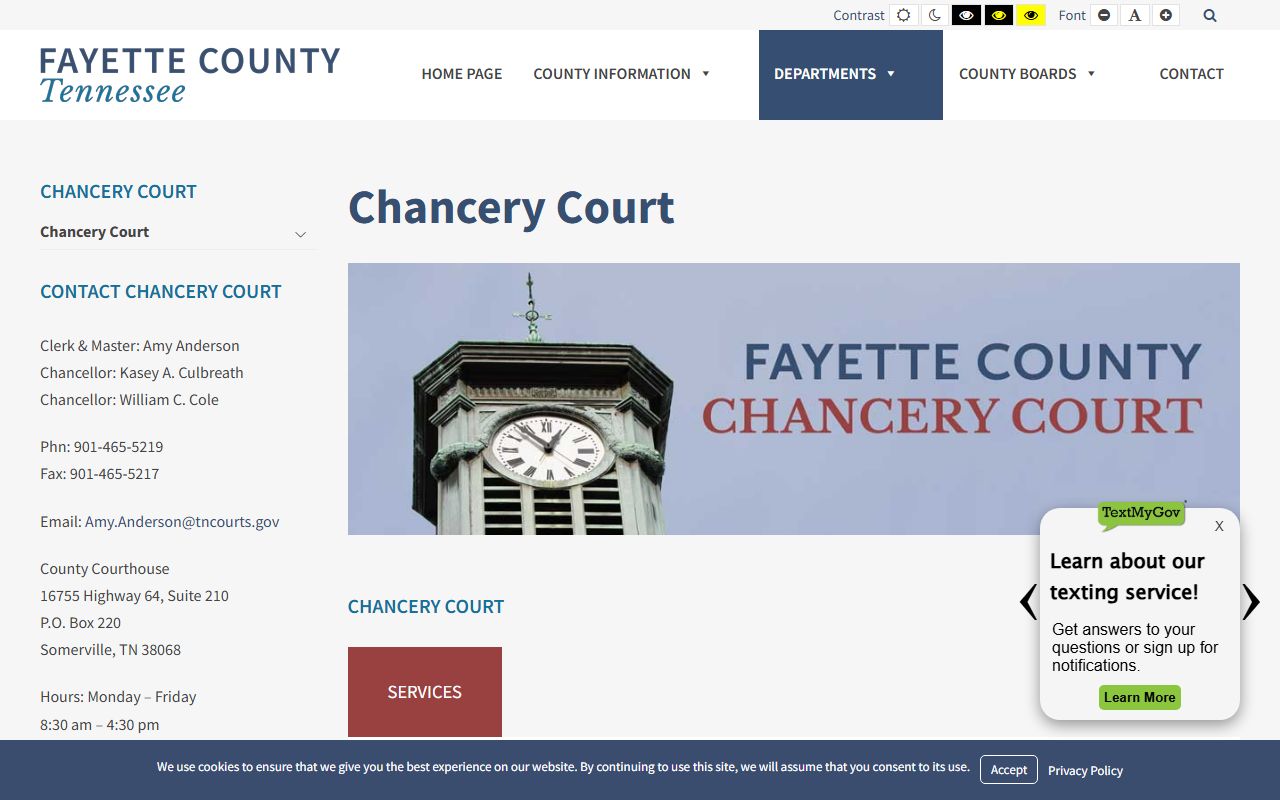
That source confirms that probate records in Fayette County route through Chancery Court instead of a separate Probate Court.
The Cornell Legal Information Institute is one reference used in the research file for Tennessee statutory text that affects probate, estates, guardianship, public records, and confidentiality.

Statutory rules matter because public access, estate claims, small estates, guardianships, and record restrictions all depend on Tennessee law.
Fayette County Probate Records
Fayette County has no separate Probate Court. Probate runs through Chancery Court via the Clerk & Master. Probate records may include wills, petitions to admit a will, petitions for letters, letters testamentary, letters of administration, oaths, inventories, notices to creditors, creditor claims, exceptions to claims, accountings, orders, small-estate affidavits, guardianships, conservatorships, trusts, muniment of title matters, and will contests.
Estate files are generally public court records, but they can contain restricted material. Conservatorship medical proof, protected personal identifiers, financial-account details, and sealed filings may be withheld or redacted. Adoption records are sealed and are not treated like ordinary public probate files. A probate search should start with the decedent's name, date of death, approximate filing year, estate representative, and case number if known.
- Testator
- A person who made a will.
- Executor
- The person named in a will to carry out estate duties.
- Intestate
- Dying without a valid will.
- Guardianship
- Court authority over a minor's person or property.
- Conservatorship
- Court authority over an incapacitated adult's affairs.
Search Fayette County Probate Records
No public online probate portal was found for Fayette County. Records are searched through the Clerk & Master at Suite 210. Staff can confirm whether a file is open, whether copies can be issued, whether certified copies are available, and whether any part of the record is confidential. A request for an estate file should be specific because older names, estate names, and handwritten or archived filings can be hard to identify without dates.
- Confirm the matter is a probate, estate, guardianship, conservatorship, trust, or will-contest file.
- Gather the decedent's full name, date of death, filing year, representative name, and case number if available.
- Call the Clerk & Master at 901-465-5219 to ask about file location, fee totals, and access limits.
- Visit the Chancery office at 16755 Highway 64, Suite 210, or mail a written request to P.O. Box 220.
- Request plain copies for review or certified copies for bank, title, court, or legal use.
Note: Historical probate research may require the Tennessee State Library and Archives when the local file is older or archival.
Fayette County Estate Process
A full estate generally starts with a petition to admit the will or to appoint an administrator. The court admits the will or determines intestacy, appoints the personal representative, and issues letters. Notice to creditors is published in a county newspaper of general circulation, known creditors receive notice, and claims are filed with the court. Tennessee claim deadlines are tied to the first publication date and an outer limit from the date of death.
Estate flow: petition filed › will admitted or intestacy found › letters issued › notice to creditors › inventory or waiver › claims and taxes handled › accounting or waiver › distribution › order closing estate.
Small-estate administration may be available when the personal-property estate does not exceed $50,000 and the required waiting period has passed. Muniment of title may allow a will to pass property without full administration in the right case. The Clerk & Master can confirm local filing practice and fees.
Fayette County Probate Fees
The exact Fayette County probate fee schedule was not posted on the official county page reviewed in the research. Statewide Tennessee fee baselines were identified. Probate costs may also include publication charges, bond premiums, certified copies, service costs, taxes, and attorney fees if counsel is used. A filer should confirm the current local total before mailing a petition or copy request.
| Item | Amount or status |
|---|---|
| Opening and closing an estate other than small estate | $230 statewide statutory baseline |
| Filing a claim against a decedent's estate | $11.00, paid by claimant |
| Filing exceptions to a claim | $42.00 |
| Data-entry surcharge for a new case | $4.00 |
| Certification and seal | $5.00 statutory clerk baseline |
| Notice to creditors publication | Paid to newspaper, amount varies |
| Exact Fayette probate schedule | Not posted on the official county page |
Fayette County Divorce Records
Fayette County Chancery Court also handles divorce records. A divorce case file may include a complaint for divorce, answer, service papers, temporary orders, motions, parenting plan, marital dissolution agreement, mediation records where filed, financial affidavits, orders, and the final decree. Some divorce records are public, but sensitive personal, financial, and child-related data may be redacted or restricted.
When minor children are involved, Tennessee requires a permanent parenting plan and a parent-education seminar of at least four hours unless waived or otherwise handled by the court. Contested cases may be ordered to mediation. Certified copies of a decree are requested from the clerk that holds the case, which may be the Clerk & Master for Chancery or the Circuit Court Clerk for a Circuit-filed divorce.
| Divorce document | What it proves |
|---|---|
| Complaint | The case start, parties, grounds, and relief requested |
| Parenting plan | Custody schedule and decision-making terms |
| Marital dissolution agreement | Agreed property, debt, and support terms |
| Final decree | The official court order ending the marriage |
Fayette County Chancery Family Records
Adult name changes are filed in Chancery Court and are generally public unless tied to a sealed matter. The file may show the petition, identity information, reason for the change, hearing entry, and order. Adoptions are different. Adoption records are sealed and confidential under Tennessee law. Access to adoption records is controlled by court order or the statutory adoption-records process, not by a normal public-records request.
Chancery may also see family-adjacent equity matters, workers' compensation cases, injunctions, and delinquent-tax suits. These files can overlap with property, family, employment, or public revenue issues. The Clerk & Master should be asked whether a public docket or order can be copied when a full file contains restricted information.
Fayette County Chancery vs Circuit
Chancery Court and Circuit Court are both trial courts, but they do not keep the same records. Circuit Court is the main general civil and felony criminal court and receives many appeals from lower courts. Chancery Court handles equity, divorce, probate, estate, adoption, name-change, workers' compensation, and delinquent-tax records. General Sessions handles limited civil claims, misdemeanors, preliminary hearings, traffic, evictions, and protection orders.
| Question | Chancery Court | Circuit Court | General Sessions |
|---|---|---|---|
| Probate or estate? | Yes | Will contests can involve Circuit or Chancery | No |
| Felony criminal? | No | Yes | Preliminary stage only |
| Small civil claim? | No | Appeal or larger case | Yes, up to $25,000 |
| Divorce? | Yes | Can be filed there too | No |
| Traffic ticket? | No | Appeal or felony-related matter | County and state citations |
Fayette County Chancery Access Rules
Chancery Court records are governed by Tennessee public-access law, Tennessee Supreme Court Rule 34, and case-specific confidentiality rules. Public records may be inspected by Tennessee citizens unless an exemption applies. Court records are open unless sealed, expunged, confidential by statute, or restricted by court rule. Clerks may redact Social Security numbers, financial-account numbers, minors' names, protected addresses, and other sensitive data before releasing copies.
A request should ask for a public docket, order, or certified decree when a full file may include restricted material. Adoption records, mental-health treatment material, conservatorship medical proof, and sealed filings should not be expected through a normal public request. When the record is a court order needed for another agency, state exactly which order is needed and whether certification is required.
Fayette County Chancery Location
The Chancery office sits in the historic Fayette County Courthouse on the Somerville square, a building completed in 1925-1926 after earlier courthouses on the site. The research file describes the building as Beaux-Arts, with buff brick and concrete, a projecting entrance porch, four large columns, and a green copper dome rising to a central clock tower. The building reopened for business in January 2026 after a multi-year renovation.
The physical split between the square courthouse and the Justice Drive complex is useful for records access. Chancery Court, the Clerk & Master, the County Clerk, and general county offices are associated with the square courthouse. Circuit, General Sessions, Juvenile, the Sheriff, and the jail are at 705 Justice Drive. Sending a request to the wrong building can delay access, even when both offices are in Somerville.
For court case files that are not Chancery, use the Fayette County Circuit Court Clerk. For marriage licenses and administrative county services, use the County Clerk.